
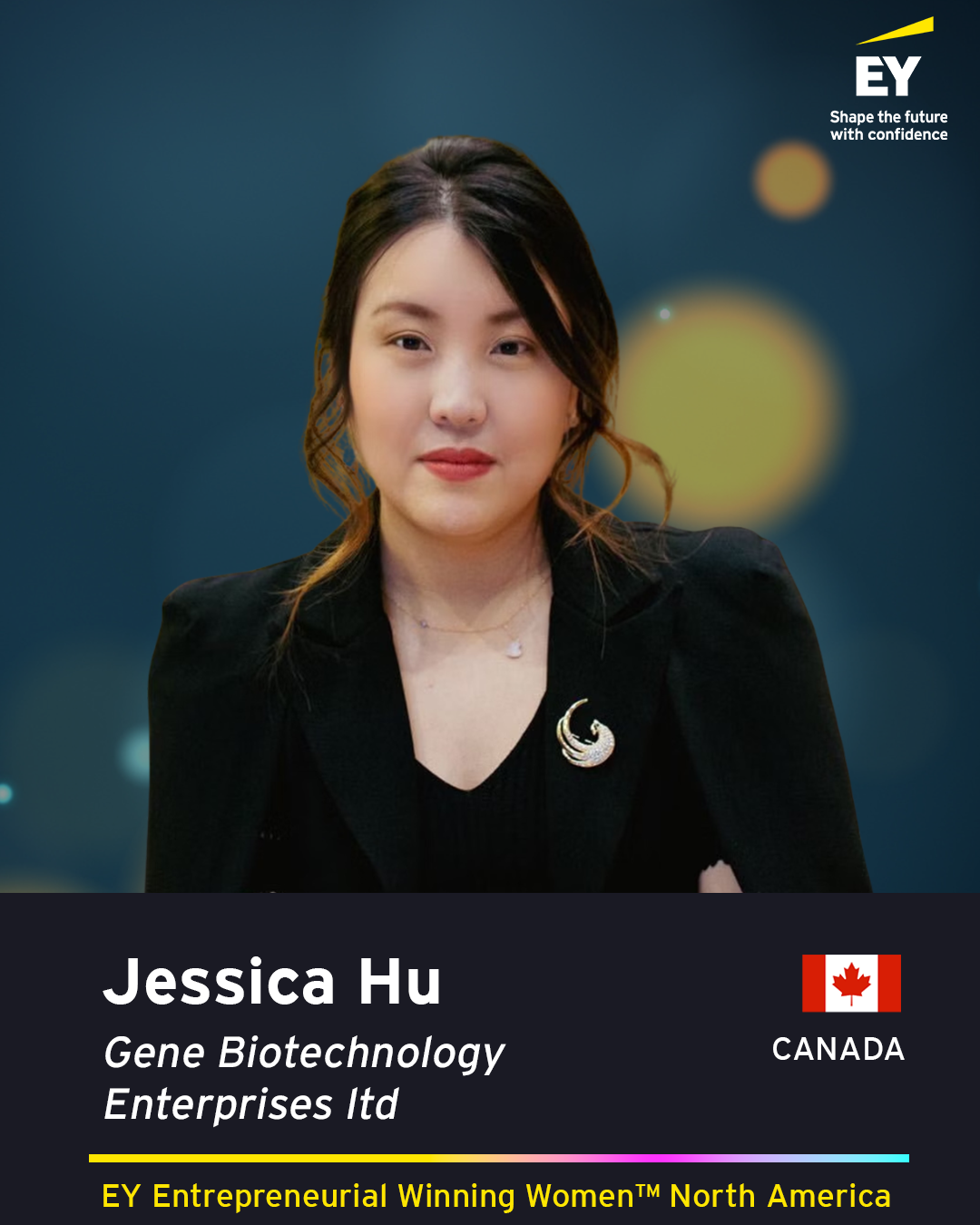
Joining a community built around sustainable growth
Jessica Hu was included in the EY Entrepreneurial Winning Women™ North America Class of 2025. EY’s official class page lists “Gene Biotechnology Enterprises ltd. | Jessica Hu” and describes Gene Bio Medical as a biotechnology company working in next-generation molecular diagnostics.
The 2025 North America class brings together woman-founded, high-growth companies from the United States and Canada across industries that include technology, professional services and health care. Inclusion in the class is participation in an entrepreneurial program and network; it should not be described as winning an award.
EY describes the broader Entrepreneurial Winning Women network as a community of founders who have built profitable companies and are working to scale sustainably. The North America program emphasizes peer relationships, access to insight, global networks and continuing business connections.
For Jessica, the relevance is practical. Founder-led companies often reach a stage where operating knowledge and personal determination are no longer enough on their own. Growth introduces questions about governance, organizational capacity, priorities, partnerships and capital readiness. Experienced peers can help a founder examine those questions from perspectives beyond her own company.
An operating business that developed into a broader platform
Gene Bio Medical began as an operating business, building market knowledge and commercial relationships through diagnostics and related health products. Over time, that experience led to a broader question: how could the company connect research, product development, production and market access more effectively? The answer has been an evolving group structure.
GBM Health Group now brings together research, commercialization and international market access across diagnostics, health technology and consumer health. The message Health Innovation, Connected. reflects this coordinating role. It does not claim that GBM invented every technology, owns every production facility or already operates at the scale of a multinational health company.
Instead, GBM aims to connect capabilities that are frequently separated. Researchers may need commercial partners. Product businesses may need regulatory planning and qualified production. Manufacturers may need brands and distribution channels. New technologies may require data expertise and clearly defined applications before they can become useful products.
The group’s work is to assemble suitable pathways around selected opportunities while maintaining responsibility for core intellectual property, brands, quality requirements and market relationships. This model is still being built. Participation in a founder network creates an opportunity to test the model against the experience of entrepreneurs who have faced the operational demands of scaling.
Molecular diagnostics and the role of AI
EY’s class profile describes Gene Bio Medical as working across research and development, manufacturing and global commercialization. It also refers to molecular diagnostic platforms incorporating artificial intelligence and addressing areas that include respiratory infections, cancer and emerging diseases.
That description provides useful context, but it must be presented carefully. Appearance on an EY profile page does not constitute independent clinical, regulatory or technical validation of a product. Individual technologies must still be evaluated on their own evidence, intended use and applicable regulatory requirements.
Within GBM’s strategy, AI is most credible when it performs a defined function. That may include supporting data analysis, identifying patterns or improving parts of a diagnostic development process. It should not be presented as a replacement for scientific validation, quality systems or professional judgment.
The same discipline applies to commercialization. International opportunity does not mean entering every market at once. Different countries have different regulatory pathways, customer needs, production strengths and distribution structures. A small company must choose where it can contribute meaningfully and where a local or strategic partner is required.
Turning recognition into better decisions
For GBM, joining the 2025 North America class is not the completion of a growth story. It is a resource for the next stage. The most useful outcome will not be the program name appearing on a website, but whether relationships and insights developed through the network contribute to better decisions.
Those decisions include which projects to prioritize, which capabilities to keep within the group, where to partner, how to strengthen governance and how to prepare the business for responsible investment. The program does not make those decisions for GBM, nor does participation guarantee financing or commercial success.
The EY listing also records an earlier stage in GBM’s organizational development. It identifies Jessica through Gene Biotechnology Enterprises Ltd. and Gene Bio Medical, while more recent positioning uses GBM Health Group and, in the 2026 finalist listing, GBM Health Holding Ltd. Those names should not be treated as interchangeable legal entities.
Participation gives Jessica a place within a North American peer community while GBM refines its structure. The significance is measured but real: an opportunity to learn from other founders, build stronger relationships and improve the decisions that will determine how the company grows.