
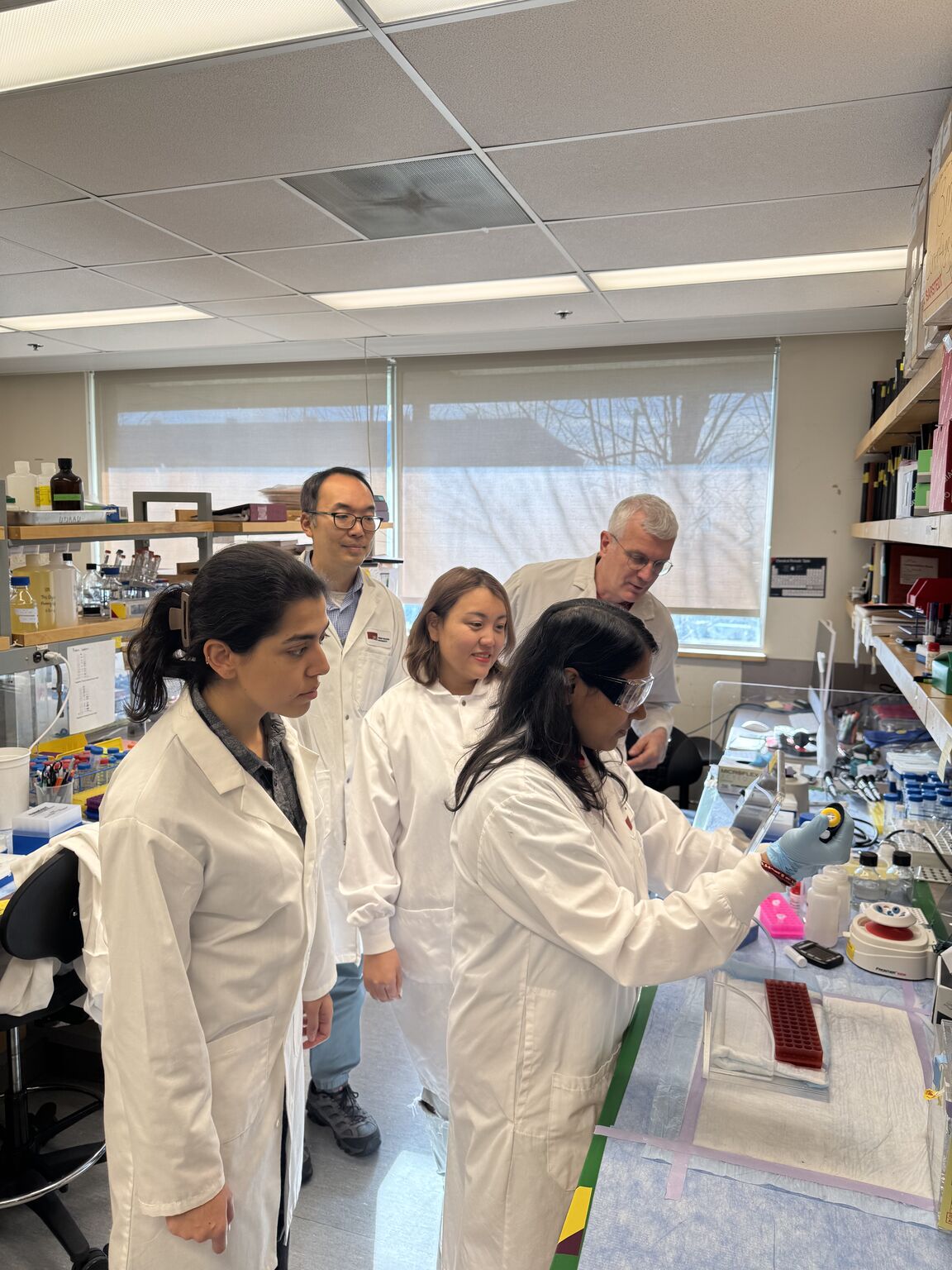
A research challenge requiring several disciplines
Developing a more accessible molecular diagnostic platform is rarely a single-technology problem. It requires reliable biological detection, appropriate sensor design, careful data interpretation, manufacturability and an understanding of how a potential product could eventually be used outside a research setting. The HPV initiative brings these areas together through a collaboration involving Geno10X Biosciences, Gene Bio Medical and Simon Fraser University researchers Michael Adachi and Peter Unrau.
Innovate BC describes the project as work toward a point-of-care platform combining rapid, highly sensitive HPV urine-testing methods with advanced AI algorithms. The research direction is to investigate whether that combination could support faster, less invasive and more accessible assessment of risks associated with diseases that include cervical and anal cancer.
That description refers to a research objective. It does not mean the platform currently diagnoses cancer, replaces established screening procedures or has demonstrated clinical performance. The collaboration is better understood as a translational program in which academic science and industry experience are connected early enough to consider product integration, manufacturing and future implementation alongside the underlying research.
Innovate BC identifies complementary capabilities in rapid nucleic-acid detection, next-generation microchip sensors, AI models, biomanufacturing and distribution. The public announcement does not assign every technical component or intellectual-property right to a specific participant, so the roles remain collective unless the parties publish more detailed agreements.
What the C$300,000 Innovate BC award supports
On November 28, 2024, Innovate BC announced C$1.5 million in Ignite funding across five separate research and development projects. The HPV collaboration involving Geno10X, Gene Bio Medical and SFU received C$300,000 of that amount. GBM did not receive the full C$1.5 million appearing in the announcement headline; that figure was the combined total distributed among all five projects.
Innovate BC’s Ignite program supports projects created through academic-industry collaboration and intended to advance technically and commercially promising solutions. Selection is meaningful external recognition of the proposed direction and the strength of the collaboration. It does not establish that development milestones, clinical evidence, regulatory requirements or commercialization have already been completed.
For GBM, the project creates a structured opportunity to connect research in molecular detection, sensors and AI with the practical questions that arise when a technology moves toward real-world use. For the SFU team, the industry relationship can add context around integration, manufacturability and possible implementation. These are benefits of the research partnership, not statements that a commercial product already exists.
A separate C$225,000 NSERC project
The Natural Sciences and Engineering Research Council of Canada lists a distinct 2024 Alliance Advantage project led by Michael Adachi at Simon Fraser University. Its official title is “Development of sensor technology for ultrasensitive detection of HPV DNA.” The public record identifies Gene Bio Medical and Geno10X Biosciences as partners and records a funding amount of C$225,000.
This project must remain separate from the C$300,000 Innovate BC Ignite award in public communications. The records involve related organizations and both concern HPV diagnostic research, but they are different funding decisions with different project titles and program structures. The two amounts should not be merged or described as one grant.
When the projects are discussed together, the accurate description is two independently documented research initiatives: a C$300,000 Innovate BC Ignite collaboration exploring an AI-enhanced point-of-care platform, and a separate C$225,000 NSERC Alliance project focused on sensor technology for ultrasensitive HPV DNA detection.
What research translation means at this stage
The value of the current work lies in building and testing the scientific and technical foundations of a possible diagnostic platform. The official records support describing the program as AI-enhanced HPV diagnostic R&D, sensor development and academic-industry technology translation. They do not support describing it as clinically validated, approved, licensed, market-ready or available to patients.
Any eventual path toward routine use would normally require further technical integration, analytical and clinical performance assessment, quality-system work and regulatory review. The official sources do not confirm that those later stages have been completed. Keeping the project’s stage visible is essential for scientific credibility and for responsible communication with researchers, partners and investors.
The project is significant because a structured collaboration is in place to investigate how sensitive molecular detection, microchip sensors and AI-supported interpretation might be connected. It is an externally supported R&D platform with named collaborators and documented funding, accompanied by the technical, clinical and regulatory work still required to move from research toward real-world use.
This stage also creates a clearer basis for future decisions. Researchers can evaluate whether the components work together as intended, while industry participants can assess development risks, quality requirements and possible routes toward validation. Publishing those next milestones only when the supporting evidence is available will make the project more understandable and more credible to potential collaborators.