
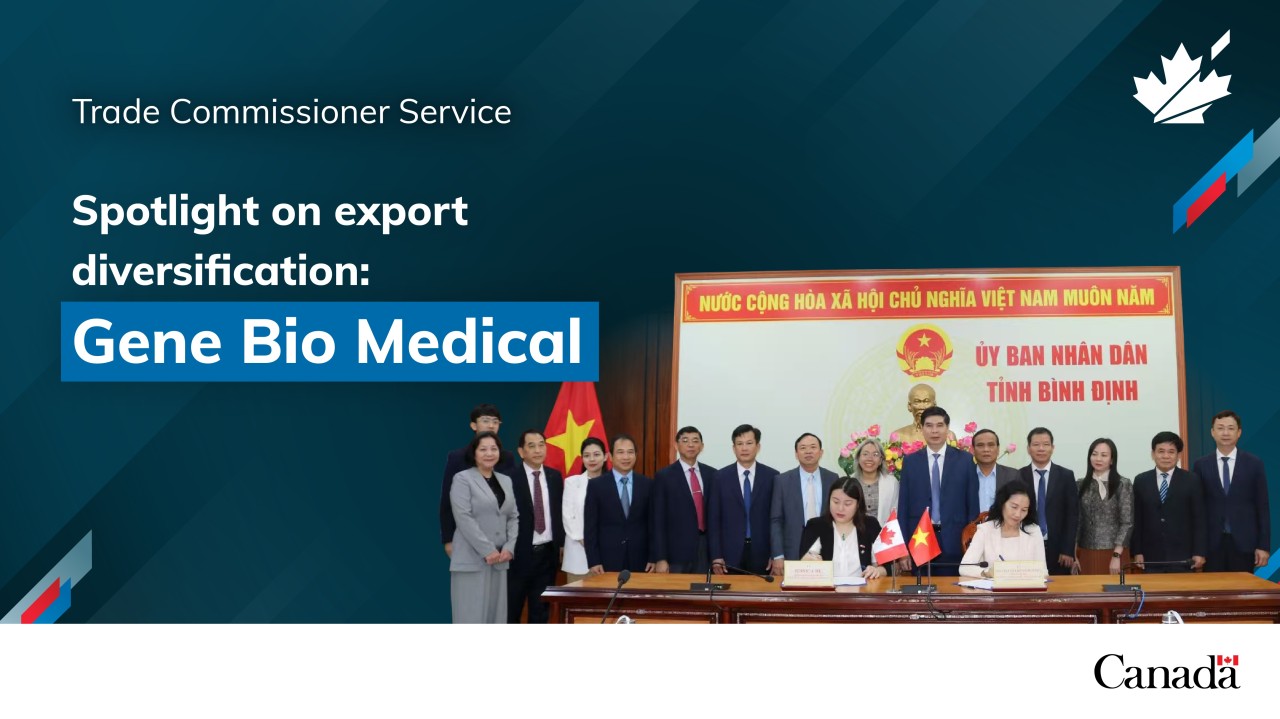
From a trade mission to a documented MOU
Gene Bio Medical’s relationship with Bidiphar developed through a sequence of export-development activities rather than through an immediate decision to establish a factory. According to Canada’s Trade Commissioner Service, Gene Bio Medical first worked with the TCS regional office in Vancouver while evaluating potential locations and partners in Southeast Asia.
The company later received CanExport SMEs support to participate in a Team Canada Trade Mission to Vietnam in March 2024. During the mission, the TCS and the British Columbia trade and investment office helped facilitate business-to-business meetings with Vietnamese pharmaceutical companies. Bidiphar was among the organizations introduced during the process and had also been identified by Gene Bio Medical as a potential partner.
Those discussions led to a joint-venture memorandum of understanding. Bidiphar’s official announcement records the signing date as February 25, 2025 and describes the intended focus as diagnostic test-kit production in Binh Dinh Province. Canada’s Trade Commissioner Service later published a detailed case study on March 18, 2026.
The legally and commercially important point is that the public record confirms an MOU to explore or establish a proposed joint venture. It does not confirm that the joint venture has been incorporated, that a facility has been completed or that manufacturing operations have commenced.
A proposed division of resources
The Trade Commissioner Service case study provides a clear description of the intended contribution from each party. Bidiphar is a publicly listed pharmaceutical company in central Vietnam. Under the proposed relationship described by the TCS, Bidiphar would provide facilities, equipment and capital investment.
Gene Bio Medical’s proposed contribution consists of intellectual property, materials, training and sales channels. This structure is consistent with a partnership model in which GBM seeks to retain and deploy health-technology capabilities, product knowledge and routes to market while working with a local organization that understands the operating environment.
These contributions must remain conditional and forward-looking. The official sources document the parties’ intended division of resources; they do not establish that all equipment, capital, intellectual property or materials have already been transferred or deployed.
The TCS also had a distinct role. Its Vancouver and Ho Chi Minh City teams provided export advice, market introductions and trade-mission support, while the British Columbia trade and investment office in Vietnam helped facilitate meetings. That support should not be represented as a government guarantee of the proposed investment or its future commercial performance.
Vietnam within a diversified operating strategy
For GBM, Vietnam can be presented as a potential component of a more diversified production and market-access strategy. The TCS case study identifies the country as an important location for Indo-Pacific sales and operations and notes that Canada and Vietnam are both members of the Comprehensive and Progressive Agreement for Trans-Pacific Partnership.
The strategic rationale is broader than production cost. A local partner can contribute knowledge of business practices, regulatory processes, language, infrastructure and customer relationships. For a smaller health-technology company, these capabilities may be difficult and expensive to build independently.
A proposed partnership in Vietnam can therefore be discussed as an effort to improve supply-chain options, create a potential regional operating base and connect production planning with future market access. Supply-chain resilience describes what the proposed partnership is intended to support, not a result that has already been achieved.
The relationship also reflects GBM’s broader operating model: maintaining responsibility for core intellectual property, brands, quality expectations and commercial channels while using qualified partners, contractual manufacturing relationships or joint ventures where local capabilities are important. The Vietnam MOU is one possible implementation of that model, subject to further agreements and execution.
From an MOU to an operating platform
An MOU is an important milestone because it records shared intent and provides a framework for more detailed work. It is not the same as an operating company, completed investment or commissioned factory. Moving to an operational joint venture would normally require definitive agreements, governance arrangements, confirmed capital commitments, facility plans, regulatory strategies, quality systems, technology-transfer protocols and commercial planning.
The official sources do not confirm completion of those steps. The accurate description is that Gene Bio Medical and Bidiphar have established a documented pathway for evaluating and developing a diagnostics partnership in Vietnam. The relationship originated through Team Canada and TCS-supported market engagement, and the proposed resource model combines complementary capabilities.
That is a substantive development for a growing company seeking to connect innovation with production and international distribution. Its credibility depends on preserving the distinction between the strategic pathway that has been agreed and the operating assets that still need to be created.
Future updates can report incorporation, investment, construction, regulatory approvals or production only when each milestone is independently confirmed. For now, the story is one of disciplined partnership development: identifying a market, working through established trade-support channels, selecting a potential local partner and documenting the next stage through an MOU.